01
Agentic coding
Plan, edit, debug, test, and explain code across large repositories with stronger tool-use discipline and clearer implementation plans.
Introducing NextLLM 2.1
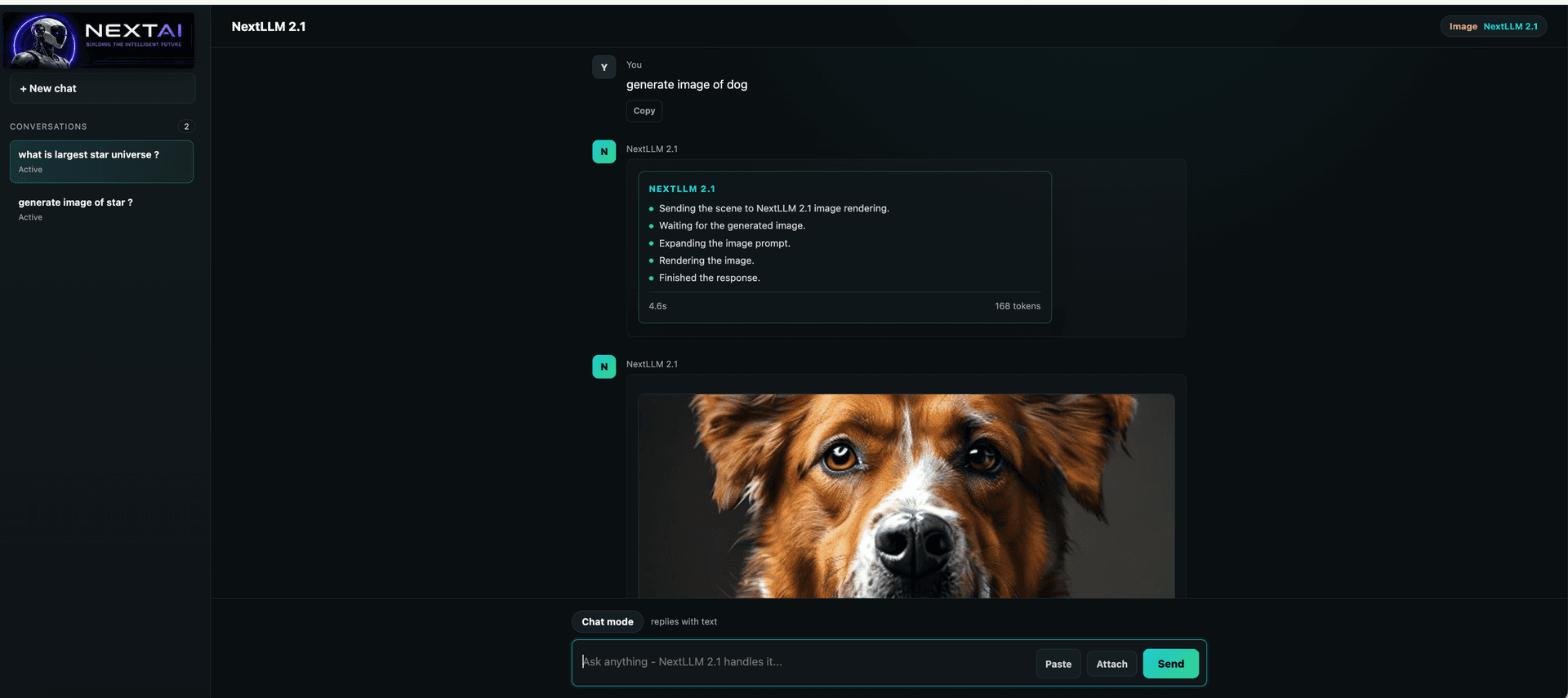
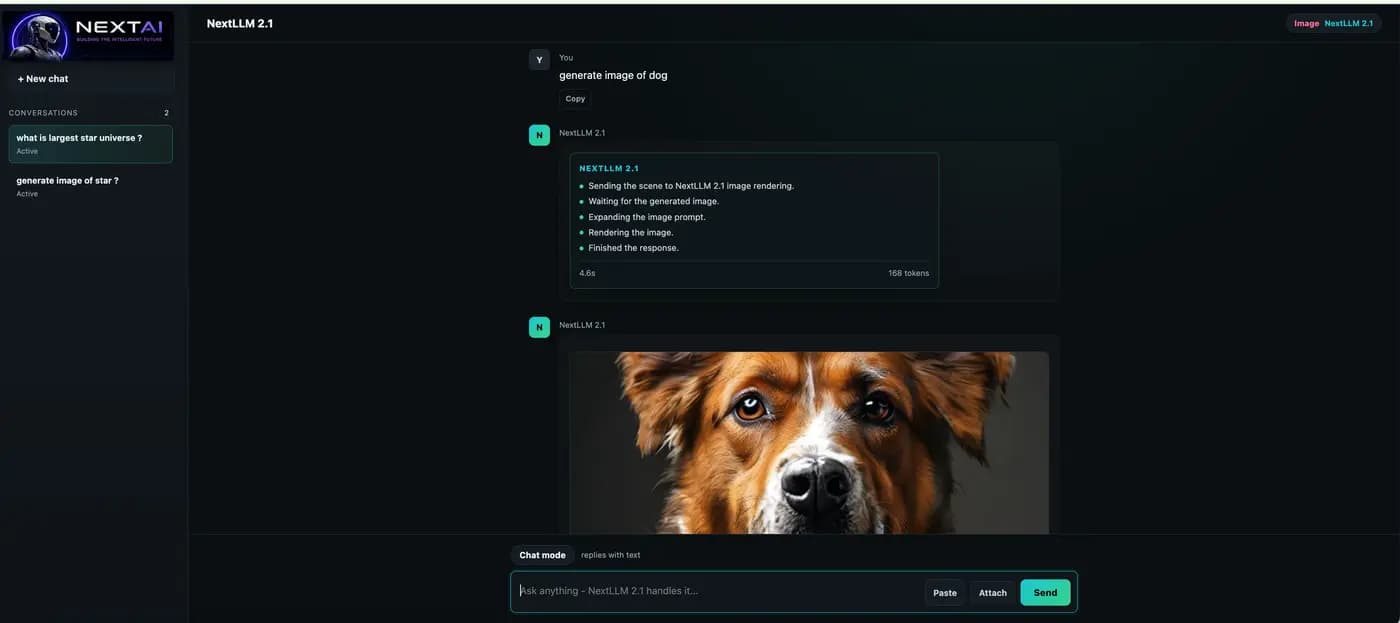
NextLLM 2.1 is NextAI's model layer for agentic coding, knowledge work, research, enterprise RAG, and image generation - designed for teams that need strong reasoning with private deployment and governed workflows.
Chat
Reason and answer
Search
Ground in knowledge
Create
Images and content
Agents
Tools and code
Model capabilities
Inspired by the new generation of launch pages for frontier models, this page presents NextLLM 2.1 around the work it enables: coding, knowledge work, research, multimodal generation, inference efficiency, and governed deployment.
01
Plan, edit, debug, test, and explain code across large repositories with stronger tool-use discipline and clearer implementation plans.
02
Turn messy business inputs into briefs, summaries, reports, spreadsheets, research notes, and decision-ready recommendations.
03
Explore technical papers, datasets, experiment notes, formulas, and multi-step analysis workflows with transparent reasoning trails.
04
Understand text, documents, screenshots, and product visuals while generating high-quality images from governed prompts.
05
Run NextLLM 2.1 through controlled private cloud, local GPU, or enterprise deployment patterns where data remains governed.
06
Power retrieval, routing, tool calls, case handling, document generation, and workflow automation from one model layer.
Agentic coding
NextLLM 2.1 is designed to power coding agents that can understand a system, propose a plan, edit multiple files, run validation, inspect failures, and keep context across the full engineering loop.
Knowledge work
NextLLM 2.1 can serve as the reasoning layer behind enterprise assistants that search knowledge bases, summarize documents, generate reports, draft presentations, classify tickets, and prepare decision-ready answers with retrieval context.
Repository-scale planning, edits, tests, terminal workflows, and implementation review.
Document generation, spreadsheet assistance, browser/task workflows, and structured outputs.
Search-grounded answers, citation-ready summaries, retrieval routing, and case deflection.
Prompt-to-image workflows, visual ideation, creative drafts, and product demo assets.
Research and analysis
Use NextLLM 2.1 to reason through technical documents, compare approaches, critique assumptions, explain experiments, and turn research artifacts into practical workflows for engineering, support, data, and AI teams.
Hands-on
Modeled as a product-ready AI system, not just a chat endpoint: build, search, reason, create, and automate from one private model layer.
01
Transform live operational data, search results, and business logic into interactive internal tools and executive-ready visualizations.
02
Upload policies, manuals, tickets, specs, and PDFs; NextLLM 2.1 summarizes, compares, extracts, and prepares action plans.
03
Create images, concepts, diagrams, and demo assets from text prompts or reference screenshots without leaving a governed workflow.
04
Use NextLLM 2.1 behind coding agents that inspect context, propose changes, run commands, and explain validation results.
Performance profile
Present NextLLM 2.1 like a modern frontier model: by the work it unlocks, the tools it can drive, and the governance required to use it in production.
Reasoning depth
Long-horizon planning for code, knowledge, and research workflows
Multimodal understanding
Text, image, screenshot, document, and code context
Agent readiness
Structured outputs, tool calls, retrieval, and workflow orchestration
Enterprise control
Private deployment, policy gates, audit trails, and human approvals
Governance and safety
Availability and specs
Package NextLLM into private assistants, agent workflows, RAG systems, coding agents, multimodal generators, and internal automation products.
Model
NextLLM 2.1
Company
NextAI
Input
Text, code, images, screenshots, PDFs, enterprise knowledge
Output
Text, structured JSON, code, reports, summaries, generated images
Primary modes
Chat, search, reasoning, coding, documents, image generation
Tool use
Function calling, structured output, retrieval, code execution, agent routing
Deployment
Private cloud, local GPU, on-prem, enterprise VPC
Best for
RAG, AI assistants, coding agents, research, support automation
Governance
Policy routing, access control, audit-ready workflows